

The False Breakout Premium
Abstract
Sack totals often dominate how NFL edge rushers are evaluated. They headline box scores, shape public perception, and frequently drive free-agent pricing decisions. That being said, sacks are among the noisiest outcomes in football; they are low-frequency events, highly sensitive to variance, and only weakly representative of underlying pass-rush process. Despite this, teams routinely commit significant cap resources to edge defenders coming off sudden sack spikes, implicitly treating these outcomes as evidence of long-lasting improvement.
Using recent NFL free-agent contracts, this study shows that edge rushers who experience large sack increases immediately before free agency receive substantially higher multi-year compensation and stronger contract guarantees than comparable non-breakout players, despite failing to deliver superior post-contract pass-rush efficiency. The results suggest the presence of a False Breakout Premium in the EDGE free-agent market, where teams systematically overpay for outcome-driven performance that does not persist.
1. Introduction
In order to evaluate whether recent sack breakouts are priced efficiently in free agency, this study analyzes a sample of NFL edge rushers who signed free-agent contracts during the 2018–2025 offseasons. Breakouts are defined as large increases in sack production, an increase of five or more sacks from the previous season, occurring in the year immediately preceding contract signing. To distinguish outcome-driven spikes from changes in role or opportunity, breakout seasons are restricted to cases in which pass-rush snap volume increased by no more than 25 percent from the prior year.
Contract values are normalized as a percentage of the league salary cap to account for variation in market conditions across offseasons and to allow for direct comparison across contracts signed in different years. The analysis then examines whether the elevated compensation awarded to breakout players is justified by post-contract pass-rush efficiency, measured using pressure rate and sack rate in the first season following signing.
This analysis proceeds in three stages. First, differences in contract commitment are evaluated by comparing the likelihood that breakout and non-breakout players receive multi-year versus single-year agreements. Second, conditional on multi-year commitment, compensation levels are compared using median salary-cap–adjusted average annual value and guaranteed compensation. Finally, post-contract performance is assessed by comparing first-year pass-rush efficiency outcomes between the two groups. This structure separates teams’ willingness to commit from the magnitude and security of compensation awarded and allows pricing decisions to be evaluated directly against realized on-field performance.
2. Data and Sample Construction
The sample consists of NFL edge rushers who signed free-agent contracts between 2018 and 2025. To focus on market-relevant contracts, the analysis excludes low-end deals below a minimum salary-cap threshold. Edge defenders are identified based on primary alignment and pass-rush usage rather than listed position alone.
Single-year and multi-year contracts are treated separately throughout the analysis. Single-year deals often reflect short-term risk management, prove-it contracts, or role uncertainty, whereas multi-year contracts represent a clearer expression of long-term valuation. As a result, compensation comparisons are restricted to multi-year contracts, ensuring that pricing outcomes reflect sustained commitment rather than short-term optionality.
2. Data and Sample Construction
2.1 Sample Construction
The sample consists of NFL edge rushers who signed free-agent contracts between 2018 and 2025. To focus on market-relevant contracts, the analysis excludes low-end deals below a minimum salary-cap threshold. Edge defenders are identified based on primary alignment and pass-rush usage rather than listed position alone.
Single-year and multi-year contracts are treated separately throughout the analysis. Single-year deals often reflect short-term risk management, prove-it contracts, or role uncertainty, whereas multi-year contracts represent a clearer expression of long-term valuation. As a result, compensation comparisons are restricted to multi-year contracts, ensuring that pricing outcomes reflect sustained commitment rather than short-term optionality.
2.2 Data Sources
Contract terms, average annual value, guarantees, and signing-year salary cap figures were obtained from Spotrac. Pass-rush statistics, including pressures, sacks, and pass-rush snap counts, were sourced from Pro Football Focus (PFF) Premium data. Salary cap figures were used to normalize compensation across offseasons to allow for direct comparison of contracts signed in different years.
3. Measuring Post-Contract Performance
Post-contract performance is evaluated using pass-rush efficiency metrics rather than aggregate production totals. Specifically, pressure rate and sack rate in the first season following contract signing are used to capture per-opportunity pass-rush effectiveness. These rate-based measures reduce the influence of snap volume, team context, and game environment, providing a clearer signal of individual performance than raw sack totals alone.
Focusing on first-year post-contract outcomes allows the analysis to assess whether the market’s valuation of breakout players is immediately validated. If sack breakouts reflect durable improvement, breakout players should be expected to outperform non-breakout peers on a per-snap basis shortly after signing.
4. Results
4.1 Contract Commitment
Breakout players are significantly more likely to receive multi-year contracts than non-breakout players. Of the breakout sample, 9 of 11 players (81.8%) received multi-year deals, compared to 65 of 104 non-breakout players (62.5%). Conversely, only 18.2% of breakout players signed single-year contracts, compared to 37.5% of non-breakout players.
This pattern indicates that teams display greater confidence in players coming off sack breakouts at the commitment margin.
4.2 Pricing and Guarantees
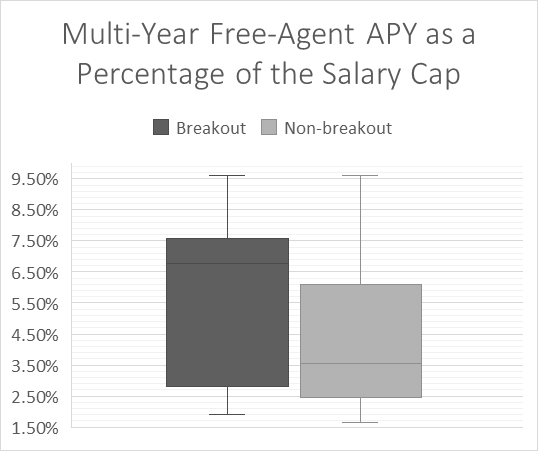
Among players who received multi-year contracts, breakout players were compensated at substantially higher levels. The median salary-cap–adjusted average annual value (APY) for breakout players was 6.76% of the salary cap, compared to 3.73% for non-breakout controls—an increase of approximately 81%.
This pricing premium extended beyond headline APY. Breakout players also received meaningfully stronger guarantees, with a median guaranteed compensation equal to 8.77% of the salary cap, compared to 4.66% for non-breakout players. The elevated guarantees suggest that teams expressed not only a willingness to pay more annually, but also greater confidence in the persistence of breakout performance.
The distribution of salary-cap–adjusted APY visually reinforces this pricing premium, with breakout players exhibiting a clear upward shift in typical compensation relative to non-breakout controls.
4.3 Post-Contract Performance
Despite receiving significantly higher compensation, breakout players did not deliver superior post-contract performance. In the first season following signing, breakout players recorded a median sack rate of 1.04%, compared to 1.85% for non-breakout players. Similarly, breakout players posted a lower median pressure rate (9.9%) than non-breakout controls (11.33%). The distribution of first-season pressure rates further illustrates this result, showing substantial overlap between breakout and non-breakout players and no upward shift in typical post-contract pass-rush efficiency for breakout signings.
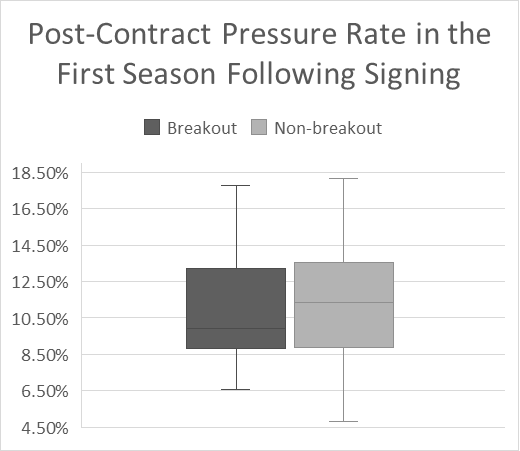
The consistency of this performance shortfall across both outcome-based (sack rate) and process-based (pressure rate) measures suggests that the pricing premium associated with breakout seasons is not supported by realized on-field efficiency.
5. Discussion
Taken together, the results indicate that NFL teams systematically overweight recent sack outcomes when pricing edge defenders in free agency. Sack breakouts are associated with higher likelihood of long-term commitment, substantially higher annual compensation, and significantly stronger guarantees. However, these investments are not matched by superior post-contract pass-rush efficiency.
This pattern is consistent with outcome bias in a market characterized by positional scarcity and competitive bidding. Because edge rushers are both valuable and difficult to acquire, teams may place disproportionate weight on salient but noisy signals such as sack totals. When such signals are mistaken for durable improvement, contract prices reflect optimism that is not borne out on the field.
Importantly, these findings do not imply that breakout players are ineffective or un-rosterable. Rather, they suggest that the magnitude and security of the compensation awarded following breakout seasons exceeds the incremental performance delivered after signing. In this sense, the inefficiency lies in pricing rather than player quality.
While the preceding results highlight systematic patterns in how edge defenders are priced following breakout sack seasons, several limitations should be noted. This analysis focuses on first-season post-contract performance and does not evaluate longer-term outcomes, which may differ for individual players. The sample is restricted to recent free-agent cycles and excludes contract extensions, which may reflect different negotiation dynamics and information environments. Although rate-based metrics reduce the influence of snap volume and team context, they cannot fully isolate individual performance from scheme, role, or supporting cast. Accordingly, the results characterize typical market outcomes rather than deterministic player trajectories.
6. Conclusion
This study provides evidence of a False Breakout Premium in the NFL EDGE free-agent market. Edge rushers coming off sharp sack increases are more likely to receive multi-year contracts, are paid significantly higher shares of the salary cap, and receive stronger guarantees than comparable non-breakout players. However, these players do not deliver superior post-contract pass-rush efficiency, indicating that teams systematically overpay for outcome-driven performance that does not persist.
For teams, the results highlight the importance of prioritizing process-based evaluation over noisy outcome measures when allocating long-term cap resources. For analysts and fans, the findings reinforce the limitations of sack totals as a standalone indicator of defensive performance. More broadly, the study illustrates how even sophisticated markets can misprice talent when volatile but salient signals dominate evaluation.