


Header: left, photo by Hayden Schiff; right, photo by Time2Football; both via Wikimedia Commons, CC BY 4.0. Cropped, color-adjusted, and darkened from the originals.
_(cropped).jpg&oldid=921046481)

On July 19, the World Cup final will kick off at MetLife Stadium, the building the Giants and Jets call home. For a month, the best soccer players alive have performed in NFL venues: AT&T Stadium in Arlington, SoFi in Inglewood, and Lumen Field in Seattle. The symbolism runs deeper than shared real estate. Somewhere in those stadiums, on those rosters, or in the academies feeding this tournament, are future NFL kickers. The league has barely gone looking for them. The few teams that have are running one of the best arbitrage plays in professional sports.
Start with the man who kicks his home games in a World Cup venue. Brandon Aubrey never attempted a field goal in college. He played soccer at Notre Dame, was drafted into MLS, washed out, and worked as a software engineer before rebuilding his athletic career as a placekicker in the USFL. The Cowboys signed him off spring league film for close to the league minimum. He became an All-Pro who treats kicks from beyond 60 yards as routine business, in the same Arlington stadium that hosted World Cup matches this summer.
Now look at what teams pay for the conventional alternative. In 2016, the Buccaneers traded a third and a fourth round pick to move up and select Roberto Aguayo 59th overall. He finished his rookie year with the worst field goal percentage in the league and was cut the following summer. He never attempted another regular season field goal. In 2019, the Vikings sent a fifth-round pick to Baltimore for Kaare Vedvik, then waived him within weeks. He never attempted a regular-season kick for them. The 49ers spent pick 99 on Jake Moody. The Patriots spent pick 112 on Chad Ryland. Both teams cut the kickers they drafted.
One acquisition strategy costs almost nothing. The other consumes real draft capital. I built a ten-year dataset to answer the obvious question: does spending draft capital actually buy better kicking?
The dataset
I assembled every kicker who attempted a field goal from 2016 through 2025. The panel covers 104 players and joins PFF kicking data to a classification I built by hand, tagging how each man entered the league so acquisition strategy could be analyzed: drafted, undrafted free agent, or what I call the nontraditional pipeline. That last group covers sport converts, CFL veterans, spring league signings, NFL Europe, and the league’s International Player Pathway program.
The nontraditional group is small and remarkable. It includes Aubrey. It includes Josh Lambo, a professional soccer goalkeeper before he ever kicked a football, and Jonathan Brown, a United States youth national team soccer player whose first field goal attempt at any level of organized football came in an NFL game. It includes Lirim Hajrullahu, born in Kosovo, a refugee who spent six seasons in the CFL before the NFL called. It includes two Irish Gaelic footballers, Charlie Smyth and Jude McAtamney, who arrived through the International Player Pathway. It includes Adam Vinatieri, who entered the league undrafted through NFL Europe’s Amsterdam Admirals and retired as the most decorated kicker in history.
All group percentages in this article are attempt-weighted, meaning the total makes are divided by the total attempts across the group, so a kicker with 300 attempts moves the number proportionally more than one with five brief appearances. One caution on reading these numbers: the undrafted figure benefits from fast failure; UDFA kickers who struggle are cut within weeks, so their misses barely register in the sample, while drafted kickers get extended chances because teams protect their investment. That asymmetry is real, and it is also the point. The undrafted market lets teams audition kickers cheaply and keep only what works. The draft pick buys a longer leash for one player, and the leash is what teams end up paying for.
The draft pick buys nothing
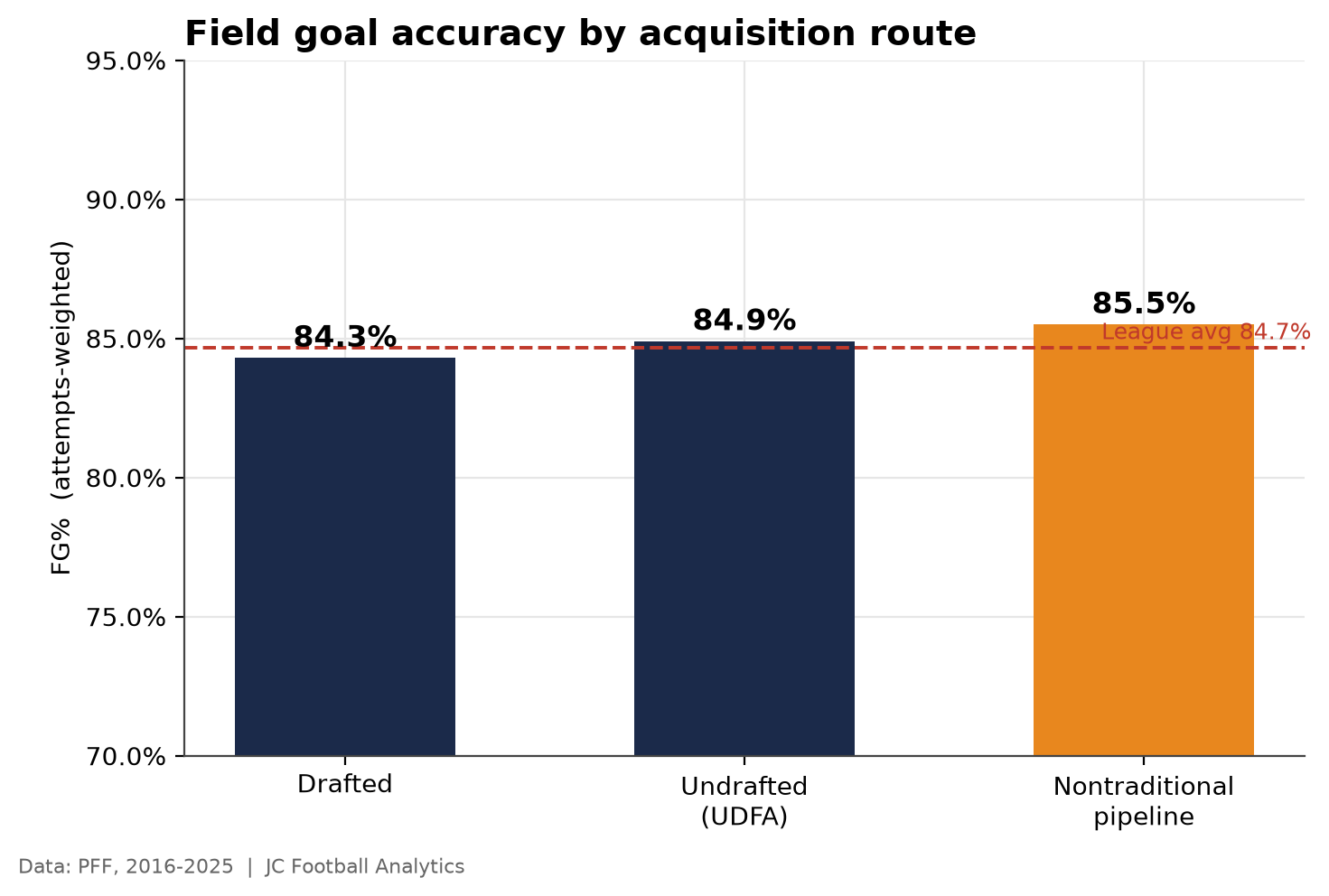
Across the full sample, kickers acquired with a draft pick made 84.3 percent of their field goals. Kickers signed for free after the draft made 84.9 percent. The league as a whole made 84.7.
Read that again. Teams that spent a draft selection, an asset with well-documented trade value, received slightly worse accuracy than teams that waited for the market to hand them a kicker at no cost. The gap is small, and I will not pretend half a percentage point separates good process from bad. The finding is the absence of any gap in the other direction. Across more than 8,000 attempts over a decade, representing 104 kickers, draft pedigree purchased zero accuracy.
The more teams paid, the worse it got
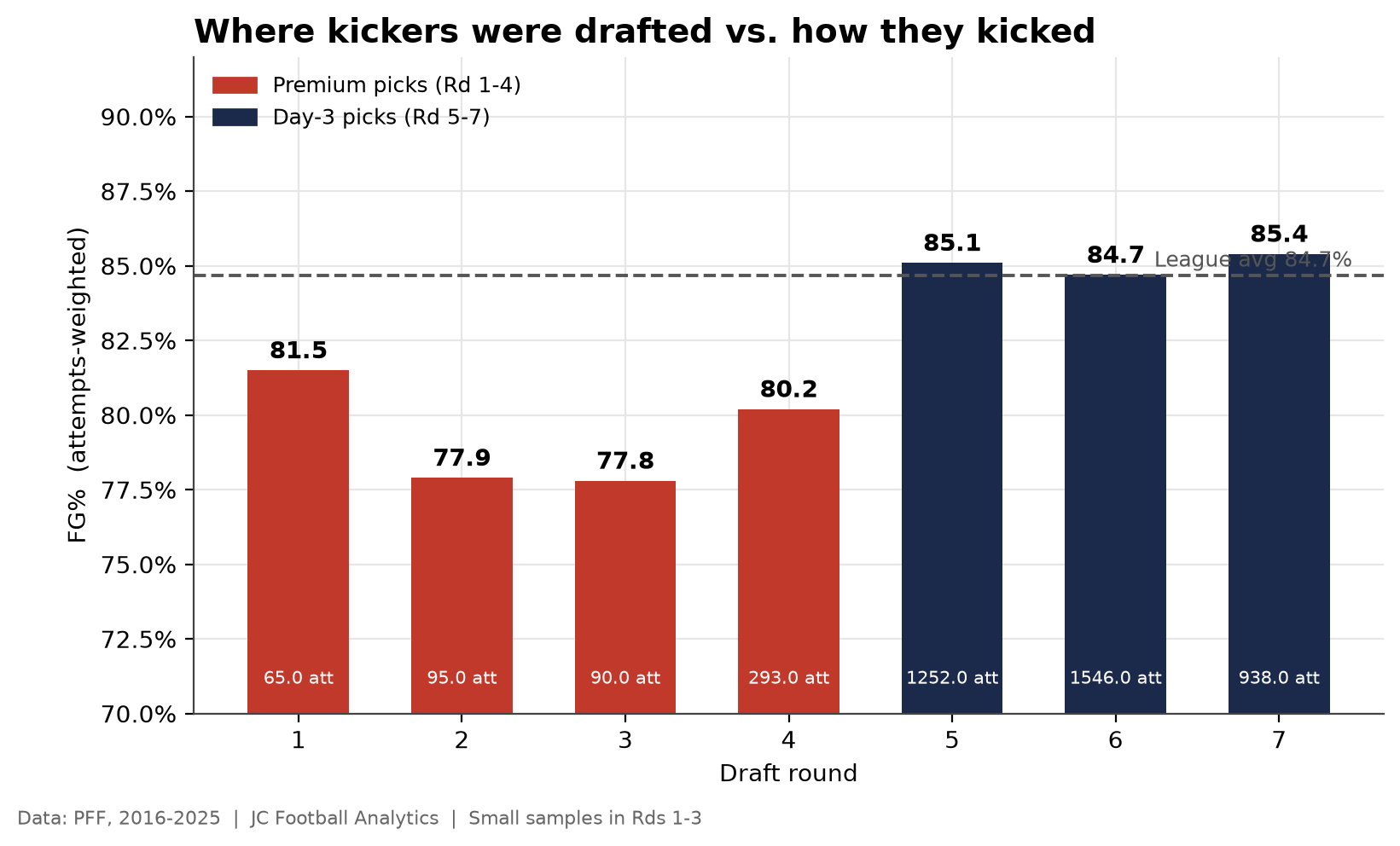
Break the drafted kickers out by round, and the picture turns from neutral to damning. Every premium group underperformed. Kickers taken in round one made 81.5 percent of their attempts. Round two made 77.9. Round three made 77.8. Round four made 80.2. All four groups sit below the league average of 84.7 percent. The cheap picks on day three tell the opposite story: rounds five, six, and seven made 85.1, 84.7, and 85.4 percent, at or above league average on more than 3,700 combined attempts.
The premium rounds carry small samples, 65 attempts in round one and under 100 each in rounds two and three, because the league has mostly stopped making this mistake, and there are few kickers to measure. Treat each individual bar with appropriate caution. The pattern across all seven rounds still points in one direction: the more a team invested in acquiring a kicker, the worse the group performed.
Even the best outcomes undercut the strategy. Sebastian Janikowski, pick 17 in 2000 and the last kicker taken in the first round, is the strongest case anyone can make for drafting a kicker: he delivered nearly two decades of service. But what those seasons delivered was roughly league-average accuracy, the same product available every year in the undrafted market for nothing. The best version of the bet still means paying a first-round pick for the free thing. Daniel Carlson, whom the Vikings traded up to select 167th in 2018, was cut weeks into his rookie season after one disastrous afternoon. He then became an All-Pro for the Raiders, who paid nothing to acquire him. The pick failed to buy the performance, even in the case where the performance eventually showed up.
The cheap pipeline kicks like everyone else
Here is the finding that front offices should pay attention to. The nontraditional group, the converts and CFL veterans and spring leaguers and Gaelic footballers, made 85.5 percent of their field goals against the league’s 84.7.
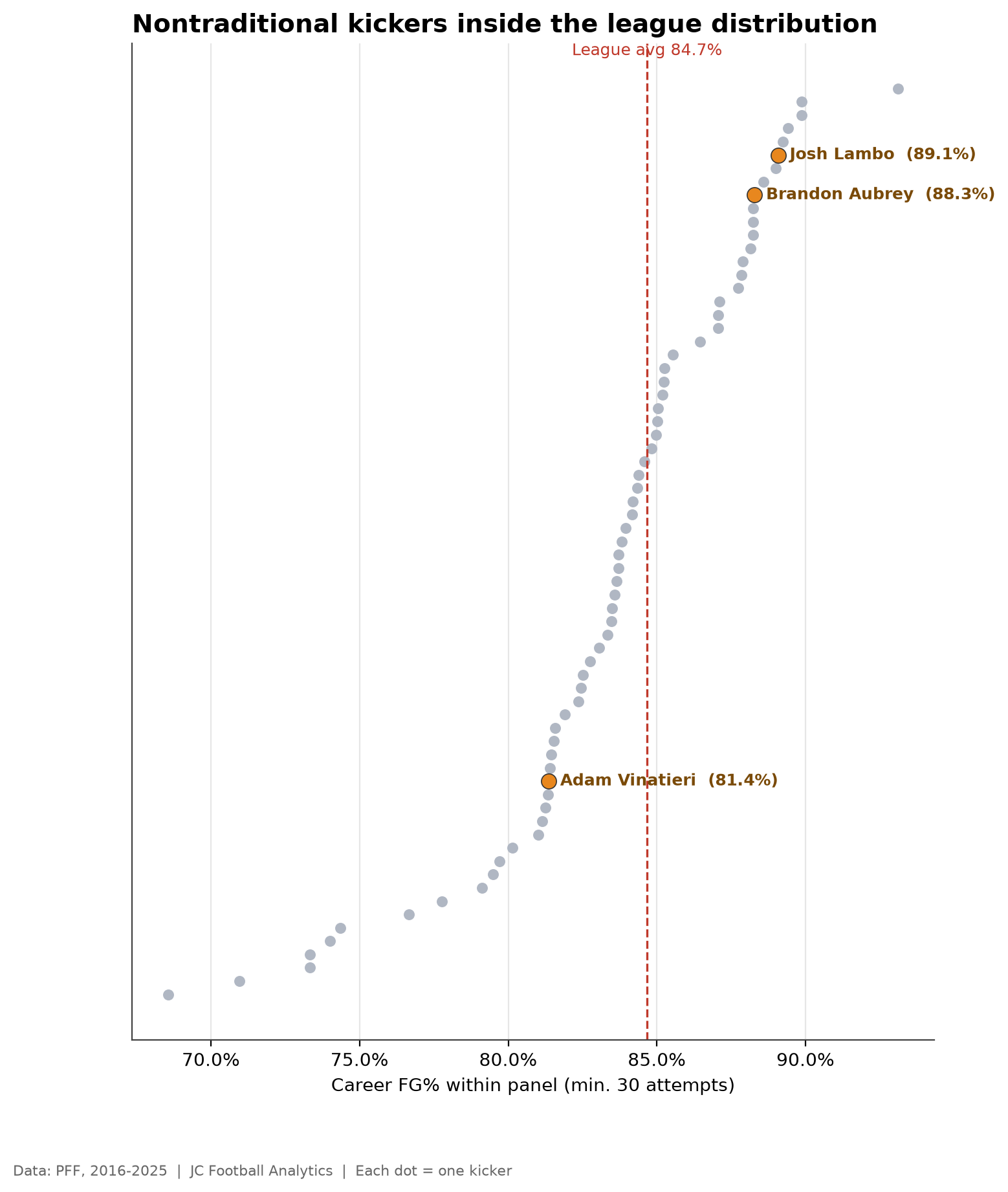
I want to be precise about what that number can and cannot support. The group holds eight kickers, and it contains brief failed auditions alongside the stars. I am not claiming soccer converts kick better than traditional prospects. The claim the data supports is narrower and more useful: teams have repeatedly identified kickers from cheap nontraditional pipelines who perform at the same level as kickers acquired the expensive way. Plot every kicker of the last decade on one axis, and the nontraditional men do not cluster at the bottom like an inferior product. They are scattered throughout the distribution like everyone else. Lambo sits near the top at 89.1 percent. Aubrey sits beside him at 88.3. Vinatieri, measured here only in his final seasons at ages 44 through 47, still lands at 81.4, inside the league’s normal working range.
What a rational front office does with this
The strategy writes itself.
Never spend a draft pick on a kicker unless you believe your evaluation process is so exceptional that it consistently beats a market that, for a decade, has shown no measurable reward for drafting one. The evidence here gives little reason to believe that is true.
Treat the alternative pipelines as scouting departments funded by someone else. The UFL stress tests kickers under professional conditions every spring, which is where Dallas found Aubrey and Detroit found Jake Bates. The CFL does the same, which is how Hajrullahu reached the league. The International Player Pathway carries a roster exemption, so a team can develop a Charlie Smyth without spending a practice squad spot. ProKick Australia has been sending the NFL a steady supply of punters for a decade, proof that a purpose-built overseas pipeline can feed the league’s specialist positions.
Then recognize what just spent a month kicking inside NFL stadiums. The population of human beings who can strike a ball 60 yards with accuracy is overwhelmingly concentrated in a sport that is not football, and the league has sampled almost none of it. Aubrey, Lambo, and Brown were not a pipeline. They were accidents, men who found their own way to the position. The first franchise that scouts soccer’s fringes as systematically as ProKick scouts Australian rules football will not be running an experiment. Ten years of data say it will be buying the same product every other team pays draft capital for, at the league minimum price.
The final whistle at MetLife on July 19 sends hundreds of elite legs home. A smart team would ask a few of them to stay.
Methodology: Kicking data comes from Pro Football Focus season-level field goal statistics, 2016 through 2025, covering all 104 players listed as kickers who attempted a field goal in that window. Punters with occasional attempts (Wishnowsky, Gillan, Pinion) and emergency kickers from other positions (Heath, Reid, Ogunbowale) were excluded. No minimum attempt threshold was applied to the group figures; the distribution chart uses a 30-attempt minimum for readability only. Each kicker was classified by initial NFL entry route, so a college product who later detoured through the UFL or CFL between NFL jobs remains in the college group, while kickers first acquired off CFL, NFL Europe, or International Player Pathway credentials are classified by that channel. Foreign birth alone does not make a kicker nontraditional; Koo, Gano, and Janikowski came up through American high school and college football. All group percentages are attempt-weighted, total makes divided by total attempts. The panel begins in 2016, so long careers that started earlier appear only in their late seasons; Vinatieri’s numbers here are his at ages 44 through 47, not his prime. Draft positions were verified against Pro Football Reference. Full dataset and code available on request.